You know you need someone answering your phones. You have been missing calls, losing jobs, and watching competitors who pick up every time pull ahead. So you start researching. You see "virtual receptionist" and "answering service" used interchangeably all over the internet — and suddenly you are confused about what you actually need.
They are not the same thing. The difference matters. And there is now a third option — AI answering — that outperforms both at a fraction of the cost. This guide breaks it all down so you can make the right call for your business.
An answering service is a company that employs a pool of live agents — usually in a call center — to answer calls on behalf of multiple businesses. When your line rings after hours (or during overflow), it gets routed to one of their agents.
See how The Call Taker answers every call, 24/7
Try Free for 14 DaysThe agent follows a fixed script you provide: your business name, your greeting, what information to collect, and where to send messages. They take the message and relay it to you by email, text, or a portal. That is essentially the entire service.
Answering services have been around since the 1950s. The model has not changed much. You are paying for a human to pick up a phone and follow a checklist.
What a typical answering service does:
What a typical answering service does NOT do:
The core limitation of answering services: Every agent reads from the same script. They cannot improvise, adapt to unusual situations, or provide real answers. If your script does not cover the question, the answer is "I'll have someone call you back."
A virtual receptionist is a more capable version of an answering service. Instead of a pool of anonymous agents working from a script, you get a dedicated or semi-dedicated team that is trained specifically on your business.
Virtual receptionists — like those at Ruby or Smith.ai — handle more than message-taking. They can book appointments, transfer calls, answer detailed questions, and act more like an actual front-desk person. They are trained on your specific business and can handle more complex interactions.
The difference is that virtual receptionists are more involved and therefore significantly more expensive. You are not just paying for someone to pick up the phone — you are paying for a trained team member who represents your brand.
What a virtual receptionist typically does:
The catch: You are billed per-minute or per-call. A busy month can mean a $900 bill instead of a $300 bill. And during peak hours, you may still experience hold times or inconsistent agent quality.
Here is where it gets clear. The fundamental difference between an answering service and a virtual receptionist is scripted vs. intelligent.
An answering service follows a fixed flowchart. An agent reads the script, fills in the blanks, and sends the message. If something falls outside the script, they are stuck. The caller gets a generic "I'll have someone call you back."
A virtual receptionist uses training, context, and judgment to handle a wider range of situations. They can recognize when a situation is unusual and adapt their response. They are closer to a real employee — but they still have shifts, call-volume limits, and quality inconsistencies.
Both options involve humans. Humans take sick days. Humans have good days and bad days. Humans put callers on hold. And with both options, you are paying for that human labor whether or not a call comes in.
Let us be specific about what these services actually cost in 2026:
Answering Services (e.g., AnswerConnect, PATLive, VoiceNation):
Virtual Receptionists (e.g., Smith.ai, Ruby Receptionists):
The per-call billing model is where businesses get burned. You sign up for a plan expecting to pay $285/month, and then you have a good marketing month or a busy season and suddenly you owe $700 in overages. One HVAC company we spoke with received a $5,100 bill from Ruby Receptionists for a single heavy month. They had no warning it was coming.
Here is what most comparison articles will not tell you: in 2026, there is a third option that did not exist a few years ago — AI-powered voice answering. And it outperforms both answering services and virtual receptionists on almost every metric that matters.
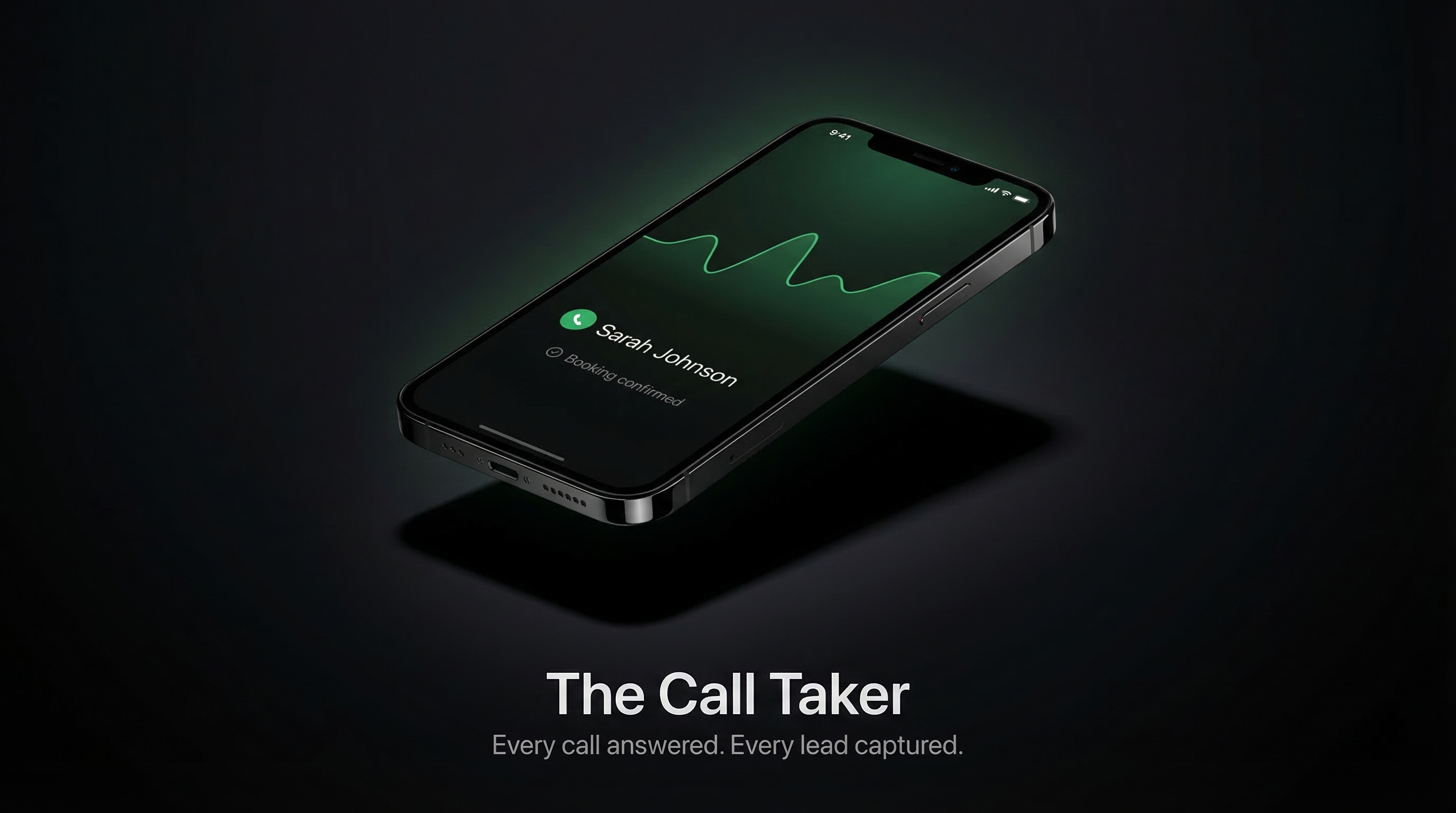
An AI answering service like The Call Taker uses advanced voice AI to answer calls the way a trained receptionist would — but without the human limitations. No shifts, no sick days, no per-call billing, no call-center background noise.
The AI is trained specifically on your business: your services, your service area, your appointment types, your pricing tiers, your emergency protocols. It handles calls with the same consistency at 2 AM on a Tuesday as at 10 AM on a Monday.
What sets AI answering apart:
The math is simple: Smith.ai charges $285/month for 30 calls. The Call Taker charges $497/month for unlimited after-hours calls. If you get 31 calls, you are already paying less with AI. Most service businesses get 80–150 calls per month.
| Feature | Answering Service | Virtual Receptionist | AI Answering (The Call Taker) |
|---|---|---|---|
| 24/7 Availability | Limited | Limited | Yes — always |
| Books Appointments | No | Yes | Yes |
| Flat Monthly Pricing | Sort of | No — per-call billing | Yes — always flat rate |
| Industry-Specific Training | Script only | Some training | Fully customized |
| Handles Emergencies | Basic escalation | Yes | Yes — triage + dispatch |
| No Contracts | Usually 3–12 mo | Often annual | Cancel any month |
| Entry Price | $50–$150/mo | $240–$285/mo | $97–$497/mo |
| Overage Risk | Yes — per minute | Yes — high per-call fees | None — unlimited |
| CRM Integration | Rarely | Some | Yes — GoHighLevel |
| Call Quality Consistency | Variable by agent | Variable by agent | 100% consistent |
| Setup Time | 1–2 weeks | 1–3 weeks | 24–48 hours |
If you are a service business — HVAC, plumbing, electrical, roofing, dental, legal — the answer is clear. Traditional answering services are too limited. Virtual receptionists are too expensive and unpredictable. AI answering services deliver better performance at a lower, more predictable cost.
The only scenario where a human answering service wins is if your calls are extremely complex, emotionally sensitive, or require nuanced judgment that AI cannot yet handle — think high-stakes legal intake or medical triage. For the vast majority of service businesses, the AI option is already better.
Call volume spikes in July when it is 95 degrees? Your AI does not care. Ten callers at 11 PM on a Saturday? Your AI handles them all simultaneously, every one perfectly. Your Ruby Receptionists team? They are going to have a very long Saturday night — and you are going to get a very large bill.
Call the demo line right now. Experience what your customers would hear — and understand why HVAC, plumbing, and electrical companies are making the switch from expensive answering services to AI.
Try the Live Demo Or call: (615) 784-5747 Start Free 14-Day PilotOur AI will call you in under 30 seconds.
Calling you now!
Pick up your phone.
We'll call your business after hours and tell you exactly what your customers are hearing. Free. No strings.
We'll be in touch!
Check your phone for a call from The Call Taker.
Or hear the AI right now: (615) 784-5747