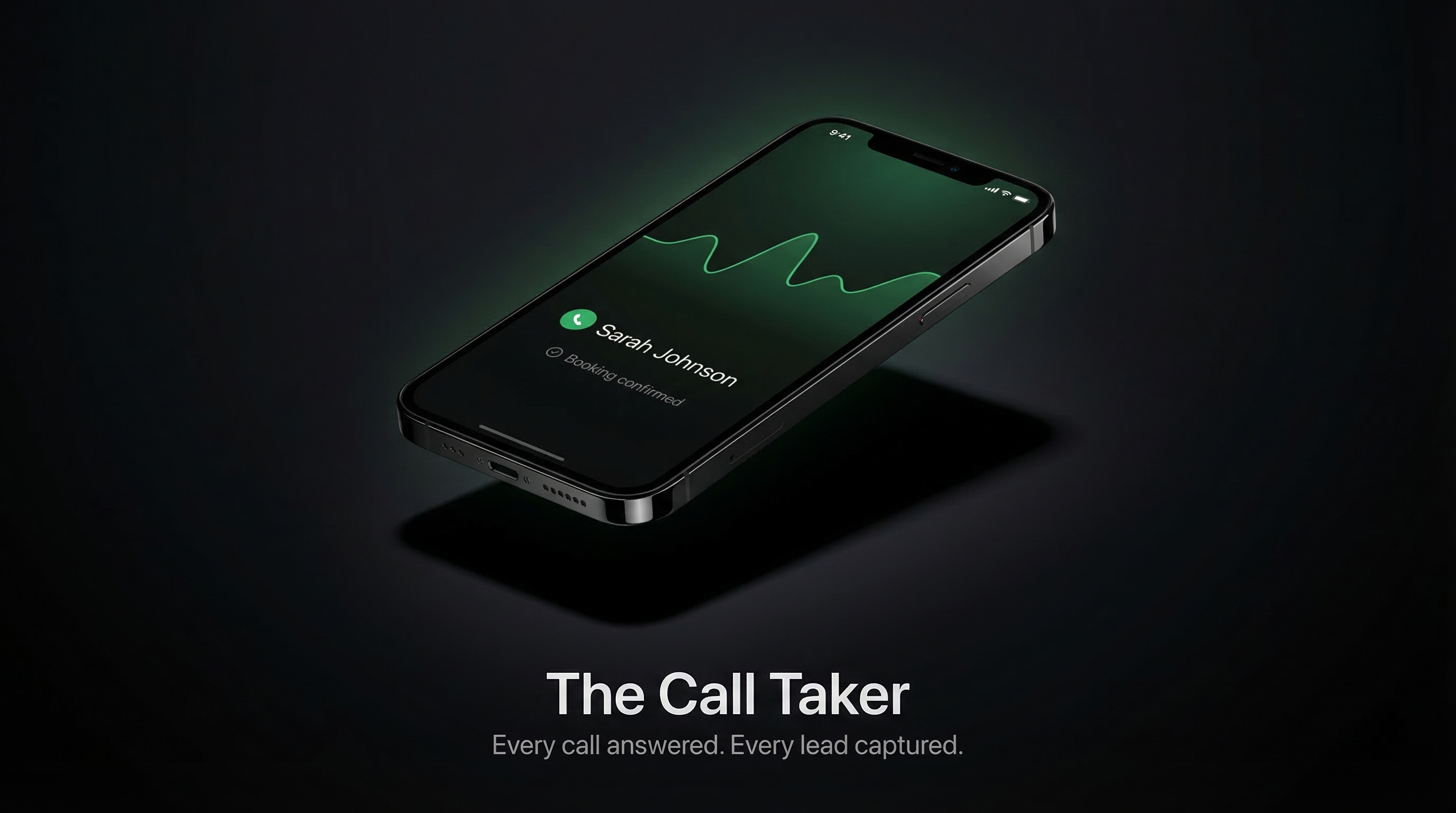
A potential customer calls your business at 9 PM. Before they finish the second ring, a voice answers — natural, conversational, using your business name. Over the next few minutes, it handles their question, collects their information, and books an appointment directly into your calendar. You wake up the next morning with a new job already scheduled.
That is an AI answering service working as designed. But if you have ever asked "how does this actually work?" — the technology behind it, what the AI understands, what happens to the call data — this guide answers that question in plain English.
Let us trace a single call from start to finish. A homeowner calls an HVAC company at 11 PM because their air conditioning stopped working.
See how The Call Taker answers every call, 24/7
Try Free for 14 DaysThe business owner has set up call forwarding. When their phone rings after 5 PM, it routes to The Call Taker. The AI answers within 2 rings with the business name: "Thanks for calling [Company Name], how can I help you tonight?" No hold music. No menu. Just a natural greeting.
The caller says "my AC stopped working and it's 89 degrees in my house." The AI does not just hear words — it processes the meaning. It recognizes this as an urgent cooling failure that likely warrants emergency dispatch. It is not reading from a flowchart; it understands context.
For an urgent situation, the AI acknowledges the urgency: "I'm sorry to hear that — with this heat, let's get someone out to you as soon as possible. I just need to get a few details from you." It does not robotically list options. It responds the way a well-trained receptionist would.
It asks for name, address, best callback number, and relevant details about the situation. It asks conversationally — not like a form being filled out. If the caller gives unclear answers, it asks for clarification naturally. The collection feels like a conversation, not an interrogation.
For an emergency, the AI sends an immediate alert (text and email) to the on-call technician with the job details. For a non-emergency, it checks available appointment slots and books directly into the calendar. The caller gets a confirmation. No message-tag, no waiting for a callback that may or may not come.
After the call, the AI sends you a complete summary: caller name, phone number, address, issue description, what was scheduled, and any notable details from the conversation. A recording and transcript are also stored. You have a full record of every call, with zero effort on your end.
Total time from call start to appointment booked: typically under 4 minutes. The homeowner's problem is handled. You wake up to a job on your schedule. The competitor who went to voicemail lost that job.
Most business owners do not need to understand the technical details — but knowing the basics helps you understand why AI answering is so different from the phone trees and IVR systems you have interacted with before.
Voice AI is not an IVR system. Interactive Voice Response (IVR) is the "press 1 for sales, press 2 for support" system. It only responds to specific inputs and cannot understand natural language. If you say "I need someone to fix my AC," an IVR has no idea what to do.
Voice AI uses large language models (LLMs) for understanding. The same type of AI technology that powers sophisticated text-based AI is now applied to voice conversations. When you speak, the audio is converted to text, processed by an LLM that understands intent and context, and then a natural response is generated and converted back to speech. This entire cycle takes under a second on modern systems.
The AI understands meaning, not just keywords. You do not need to use specific trigger words. "My heat is not working," "the furnace went out," "no heat at my house," and "my heating system stopped" all mean the same thing to the AI. It processes intent, not just vocabulary.
The voice is generated, not recorded. The AI does not play back pre-recorded clips of a human voice. It generates natural-sounding speech in real time from the text it wants to say. This is why it can say any name, address, or piece of custom information without sounding like a spliced recording.
This is where AI answering diverges most sharply from generic phone systems. The AI is not a one-size-fits-all product — it is trained and configured specifically for your business.
Industry-specific knowledge. An HVAC company's AI knows the difference between a refrigerant issue and a thermostat problem. A dental practice's AI knows what a new patient intake call looks like versus an existing patient rescheduling. This knowledge comes from training the AI with industry-specific information before deployment.
Your business specifics. During onboarding, you provide: your service area (the AI knows which zip codes are and are not in your coverage zone), your appointment types and durations, your emergency protocols (who gets called, how, in what order), your pricing tiers if you want the AI to quote ranges, and any business-specific policies.
Your brand voice. The AI is configured to answer with your business name, use your preferred tone (professional, warm, direct), and follow your specific call-handling preferences. It sounds like your business — not like a generic AI assistant.
Ongoing refinement. Call recordings and transcripts let you review how the AI handled specific conversations. If you want it to handle a particular type of call differently, the configuration is updated. The system improves over time based on real call data from your specific business.
Honesty matters here. AI answering is genuinely powerful, but there are things it does not do — and businesses that understand these boundaries deploy it far more effectively.
The "cannot do" list is actually a feature, not a limitation. An AI that says "I'll have the technician assess that and give you an exact price" is doing the right thing. You do not want an AI quoting prices that may be wrong or making commitments you have not authorized.
Many business owners think of AI answering as "a chatbot that talks." This is a significant misunderstanding, and it leads to wrong expectations.
Phone calls are still the primary channel for service businesses. 93% of service business leads still come in via phone. A website chatbot serves the 7% who prefer to type. AI voice answering serves the 93% who call.
The technology also differs fundamentally. Most chatbots are rule-based decision trees. AI voice answering uses large language models that understand natural language and context — the same family of technology as advanced AI assistants, but optimized for real-time voice conversation.
The best way to understand how this works is to experience it. Call the demo line right now — it is a live AI that will adapt to whatever industry you describe.
Try the Live Demo Or call: (615) 784-5747 — available 24/7Reading about how AI answering works is useful. Experiencing it is different. The demo line at (615) 784-5747 is a live AI receptionist that operates 24/7. It is configured as a universal demo — meaning it adapts to whatever kind of business you describe.
Call it and say you are a homeowner with a plumbing emergency. Call it and say you are a dental patient trying to schedule a cleaning. Call it and say you are a homeowner whose HVAC unit stopped working at 2 AM. Watch how it handles each scenario — how it responds, how it collects information, how it would route your call if this were a real business.
That is what your customers would experience. That is how you answer every call, 24/7, starting 48 hours after setup.
For industry-specific information on how AI answering is deployed across different service businesses, visit the Industries page or the AI vs Alternatives comparison.
The demo line at (615) 784-5747 is live 24/7. Call it, describe your business, and see exactly what your customers would experience. Then start your free 14-day pilot and put it to work for your business.
Try the Live Demo Call (615) 784-5747 — live right now Start Free 14-Day PilotOur AI will call you in under 30 seconds.
Calling you now!
Pick up your phone.
We'll call your business after hours and tell you exactly what your customers are hearing. Free. No strings.
We'll be in touch!
Check your phone for a call from The Call Taker.
Or hear the AI right now: (615) 784-5747