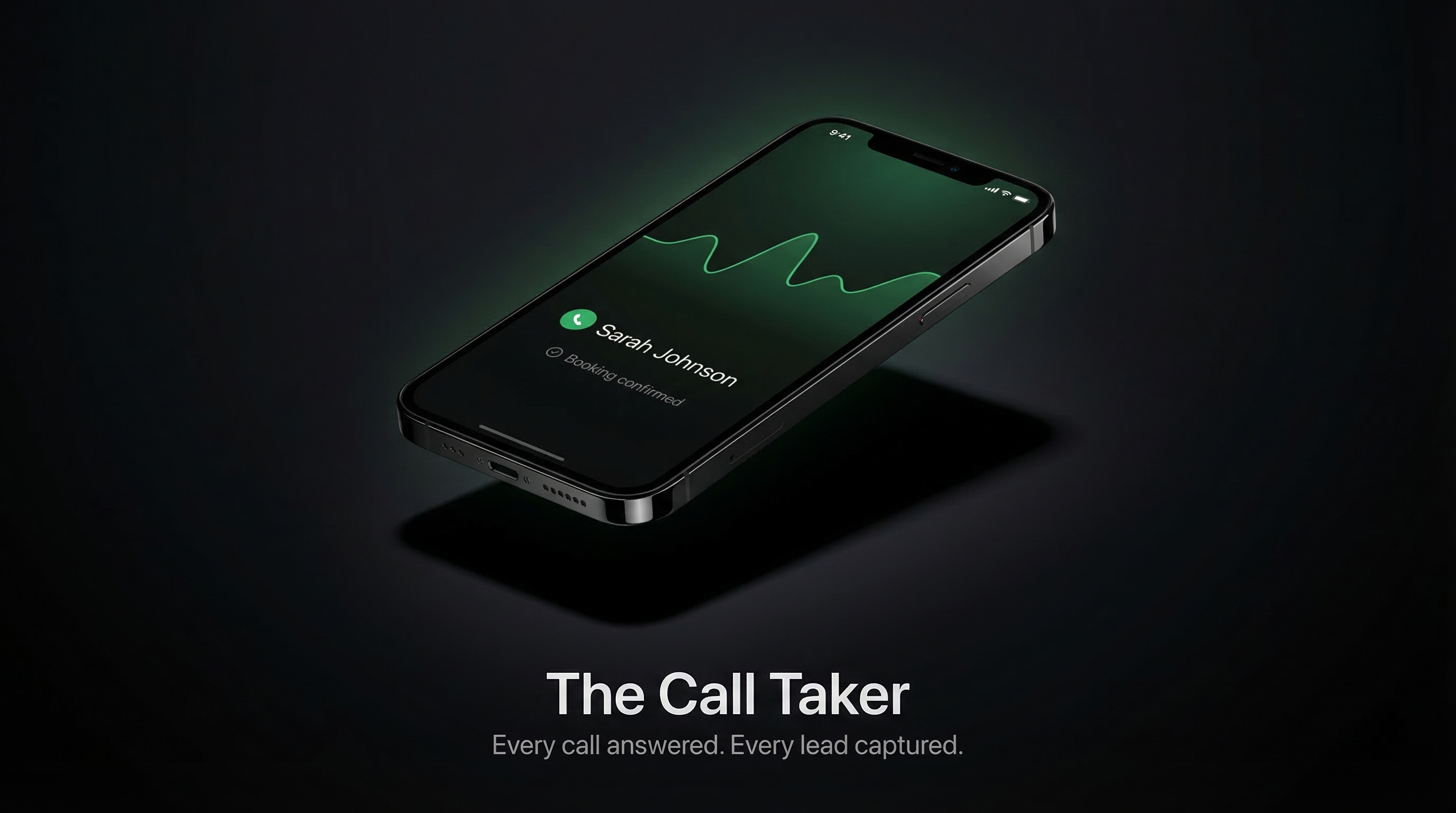
More than half of all calls to service businesses come outside normal business hours. The homeowner whose AC dies at 8 PM is not going to wait until 9 AM Monday. They are going to call until someone answers. If that someone is not you, it is your competitor.
This is why 24/7 phone answering matters -- not as a luxury, but as a basic business necessity for service companies. The question in 2026 is no longer "should I have 24/7 coverage?" It is: should I use an AI answering service or a traditional call center? Here is the honest answer.
The data on after-hours call volume is consistent across industries. Service businesses that track their call timing find the same pattern:
See how The Call Taker answers every call, 24/7
Try Free for 14 DaysPut those three numbers together. If 62% of your calls come after hours and you are not answering them, you are operating at roughly 38% of your potential capacity. Every missed call is a lead you paid to acquire -- through Google Ads, word of mouth, SEO, or your truck wrap -- that you are giving away for free to a competitor who answers their phone.
The dollar math is simple. If your average job is worth $350 and you miss 8 after-hours calls per week, you are losing approximately $1,176 per week in revenue, or $61,152 per year. For a flat monthly fee, 24/7 answering converts many of those lost calls back into booked jobs.
The traditional solution to after-hours calls has been the 24/7 answering service -- a call center staffed by agents who pick up your overflow and after-hours calls. In theory, it works. In practice, there are four persistent problems.
Call center jobs are among the highest-turnover positions in the US economy. Average annual turnover rates exceed 45%. That means the person answering your calls at 2 AM might be in their first week on the job, reading from a script they barely understand, with no real knowledge of your industry.
For a homeowner calling about a no-heat emergency, talking to an undertrained call center agent who says "I'll have someone call you back" is almost as bad as reaching voicemail.
During peak season -- AC failures in August, furnace failures in January -- your call volume can triple. Traditional call centers charge per-minute or per-call. During a heat wave, HVAC companies on per-minute plans can receive bills 3x their normal monthly cost. Worse, some call centers simply put callers on hold when volume exceeds capacity, which destroys the experience.
Many call centers handle business hours with US-based agents and overnight with offshore teams. The quality gap between the two is often significant. Callers who reach an offshore agent at 11 PM -- especially in high-urgency situations like no heat or a water leak -- frequently report frustration with communication clarity and script-reading rather than genuine helpfulness.
A generic call center agent has no training in your industry. When an HVAC caller says "my blower motor is running but no heat is coming from the registers," the call center agent writes down "heat not working." The diagnostic nuance that could help you prioritize your technician dispatch is lost.
The core problem: Traditional call centers were designed to handle volume. They were not designed to deliver the professional, knowledgeable first impression that wins customers in competitive service industries.
Modern AI phone answering uses large language models -- the same underlying technology as ChatGPT -- combined with natural text-to-speech voice synthesis. The result is a phone conversation that sounds and feels remarkably close to talking to a human.
Here is what happens on a typical call:
The critical advancement between 2023 and 2026 is response latency. Early AI phone systems had 3-5 second pauses between the caller speaking and the AI responding. Modern systems respond in under one second, making the conversation feel natural rather than robotic.
Call The Call Taker demo line at (615) 784-5747 to hear this in action.
| Category | AI Answering | Human Call Center |
|---|---|---|
| Availability | 24/7/365, no exceptions | Varies; holiday coverage is expensive |
| Response speed | Answers in 2-3 rings, always | Hold times during surge periods |
| Consistency | Identical script every call | Varies widely by agent and shift |
| Industry knowledge | Trained on your specific industry | Generic scripts, minimal training |
| Monthly cost | $97 – $497 flat rate | $150 – $800+, per-minute overages |
| Peak season cost | Same flat rate | Bills 2x-3x during high volume |
| Complex emotional calls | Handles well; escalates if needed | Human empathy advantage |
| Language support | English (Spanish expanding) | Multiple languages available |
| Setup time | 48 hours | 1-2 weeks |
| Contract required | None (month-to-month) | Often annual contracts |
AI wins on 8 out of 10 categories. The two areas where human agents still hold an advantage are complex emotional calls and multi-language support -- important for some businesses, less critical for most.
Traditional 24/7 call center services charge in one of three ways: per-minute, per-call, or monthly bundles with sharp overage fees. For a busy service business, the cost can be unpredictable and surprisingly high.
Here is a real cost comparison for a mid-size HVAC company handling 150 calls per month:
That savings adds up to $3,036 to $5,436 per year -- without accounting for the additional revenue from captured after-hours calls that the AI handles better than an undertrained overnight call center agent.
No-heat in January. AC failure in August. These are genuine emergencies that generate high-urgency calls at 10 PM, 2 AM, and 6 AM. The AI handles emergency triage -- identifying true emergencies vs. comfort issues -- and alerts your on-call technician immediately. A generic call center takes a message.
Burst pipes and overflowing toilets do not wait for business hours. A caller with water actively flooding their basement at midnight needs to know help is coming -- not that someone will call back tomorrow. AI can dispatch your emergency line within seconds of the call ending.
Dental emergencies -- severe toothaches, broken teeth, lost crowns -- often happen at night and on weekends. The AI captures the patient's information, describes what they should do immediately, and books the first available appointment. Patients feel cared for even when the office is closed.
Potential clients shopping for a personal injury attorney, family law firm, or DUI defense often call outside business hours -- they are researching their options from home, after work. An AI that captures their information and books a consultation call converts that lead before it shops three more firms in the morning.
See how The Call Taker handles calls for your specific industry at thecalltaker.com/industries.
AI answering is the clear choice when:
Human receptionists and call center agents still outperform AI in a few specific scenarios:
For most service businesses -- HVAC, plumbing, electrical, dental, legal, roofing -- these exceptions represent a small fraction of total call volume. The 95% of calls that follow predictable patterns are handled better, faster, and cheaper by AI.
The path from voicemail or a legacy call center to a live AI answering service takes about 48 hours. Here is the process:
The Call Taker offers a free 14-day pilot so you can test with real calls before paying anything. Most businesses capture their first missed-call conversion within the first 48 hours of going live.
Most businesses that switch to 24/7 AI answering see a predictable pattern in their first month. Here is what to expect:
You start seeing how many calls you were actually missing. The AI's call log shows every call that came in -- including the ones at 8:47 PM and on Sunday morning that previously went to voicemail. Most business owners are genuinely surprised by the volume. Expect a mix of emotions: validation that the system is working and frustration about how long those calls were going unanswered.
The calls start converting into booked appointments. Calls that would have been $0 (missed voicemails that led nowhere) are now showing up as jobs on your calendar. For service businesses, expect to see 3-8 additional booked jobs in the first 30 days from calls that were previously lost.
By week four, you have enough data to see patterns. Which call types generate the most revenue? What time do most emergency calls come in? Are there specific FAQs that need better answers? This is where you tune the AI's training to match your real call data, improving conversion further.
Most businesses that pilot 24/7 AI answering for 30 days do not go back. The combination of captured revenue and reduced interruptions during service delivery creates an obvious business case that the numbers confirm in black and white.
The free 14-day pilot at The Call Taker is designed precisely for this discovery phase. You see your actual missed call volume, your actual conversion rate, and your actual added revenue -- all before paying a cent. Start at thecalltaker.com/pilot.
Compare how different industries use 24/7 AI answering on the industries page -- each has specific call flows and ROI calculations built out.
Call (615) 784-5747 right now -- that is a live AI demo. It adapts to any industry. Try your free 14-day pilot and see how many after-hours calls you have been missing.
Start Free 14-Day Pilot Or call the demo line: (615) 784-5747Our AI will call you in under 30 seconds.
Calling you now!
Pick up your phone.
We'll call your business after hours and tell you exactly what your customers are hearing. Free. No strings.
We'll be in touch!
Check your phone for a call from The Call Taker.
Or hear the AI right now: (615) 784-5747